
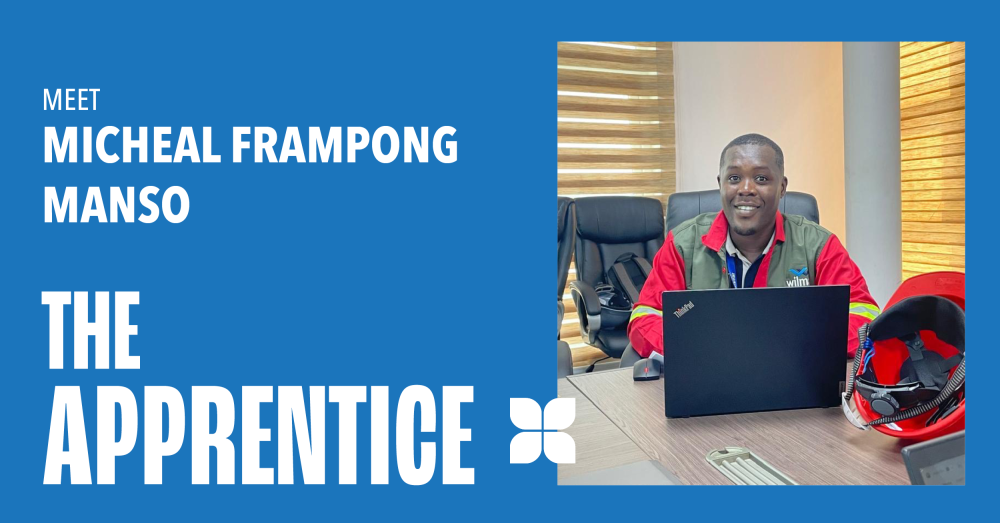
More Than a First Job: How Mentorship Shaped Micheal Frimpong Manso's Career
Ask Micheal Frimpong Manso what has made a difference in his professional journey, and one thing stands out beyond technical skills, job titles, or promotions.
Mentorship.
"The heart of my tremendous growth lies the invaluable influence of mentorship," he reflects.
For Micheal, who joined the PFS Apprenticeship Program in 2020, the opportunity to learn from experienced professionals became an important part of finding his footing in the food industry.
What began as an apprenticeship at Taste Cocoa Ghana Limited would introduce him not only to the realities of food manufacturing but also to people whose knowledge, guidance, and perspectives would help shape his approach to work.
Finding His Footing in the Food Industry
With a Bachelor of Science degree in Biochemistry from the University of Cape Coast, Ghana, Micheal entered the PFS Apprenticeship Program eager to put his academic knowledge into practice.
His placement at Taste Cocoa Ghana Limited provided that opportunity.
Working in a real food manufacturing environment, he gained firsthand experience in quality management and food safety while learning how to navigate the everyday demands of professional life.
He developed skills in teamwork, time management, Lean Six Sigma, and continuous improvement. He also became more confident in taking ownership of tasks and working with minimal supervision.
But beyond these practical lessons, Micheal found particular value in the professional relationships he was building.
The apprenticeship connected him with experienced professionals who could offer guidance, share their knowledge, and introduce him to different ways of approaching workplace challenges.
These connections would become one of the most meaningful aspects of his experience.
Learning Through the Eyes of Experience
One of Micheal's mentorship experiences as an apprentice was with PFS volunteer Regina Barcena, whose guidance provided an opportunity to deepen his understanding of food safety, quality, and process improvement.
For Micheal, the experience was both exciting and eye-opening.
"I have been very excited about this mentorship program. I have gained a lot of insight into food safety and quality and also process improvement," he shared.
Beyond the knowledge gained, he recognized the potential the experience held for his future.
"I strongly believe this training and mentorship I have had will propel my career development to a different dimension more than I even expected."
His reflections capture the value of having access to someone with industry experience who can help a young professional see beyond their immediate responsibilities and consider new possibilities for their career.
Micheal also participated in a separate mentorship engagement with Kate Mamoucha, which offered another opportunity to exchange ideas, discuss challenges, and explore solutions.
For Kate, what stood out was Micheal's attitude toward learning.
"Michael was very open and sincere, sharing challenges and always willing to find solutions," she reflected.
She also described the experience as "a good mentorship relationship with a person willing to learn and grow."
Her observations reveal another important side of mentorship: while access to experienced professionals creates opportunities for learning, the willingness to engage openly and act on guidance is equally important.
As Kate noted, successful mentorship requires mentees to approach conversations with clarity and a willingness to learn, while both parties remain flexible and understanding of the challenges each may face.
In Micheal's case, that openness to learning became a defining part of his mentorship experience.
Taking the Lessons Into the Workplace
Micheal's apprenticeship eventually came to an end, but his journey at Taste Cocoa Ghana Limited was only beginning.
He was retained by the company and went on to spend more than four years there, taking on roles that required increasing responsibility, strategic thinking, problem-solving, and team leadership.
His final role at Taste Cocoa was Environmental, Health and Safety (EH&S) Manager, where he supported the implementation of environmental and social frameworks and promoted the safety and wellbeing of employees and stakeholders.
Today, Micheal serves as an EHS Supervisor at Wilmar Africa Limited, continuing to build on the professional experience he has gained over the years.
While his career progression reflects his growing responsibilities, Micheal's own reflections point to something beyond job titles.
He credits the apprenticeship and the mentorship opportunities it provided with helping him navigate the challenges of professional life, continually strengthen his abilities, and contribute meaningfully to the organizations he has worked with.
For him, the value of mentorship was not limited to learning technical concepts. It also lay in gaining perspectives and building professional relationships that helped him approach his career with greater confidence.
The Lasting Value of Mentorship
Micheal's experience offers a reminder that mentorship is not simply about one person sharing knowledge with another.
It is also about creating space for honest conversations, asking questions, working through challenges, and being open to different perspectives.
Through his engagements with Regina Barcena and Kate Mamoucha, Micheal experienced different dimensions of that exchange, from strengthening his technical understanding to engaging in conversations that encouraged openness and problem-solving.
His story also highlights the important role that PFS volunteers play in supporting emerging talent in Africa's food industry.
By sharing their time, expertise, and professional experiences, volunteers create opportunities for young professionals to learn from people they might not otherwise have access to.
And as Micheal's journey demonstrates, the value of those connections can extend well beyond an apprenticeship placement.
From a young Biochemistry graduate entering the food industry to an experienced professional working in environmental, health, and safety, Micheal has continued to build his career on a foundation of learning, experience, and meaningful professional relationships.
His story reminds us that while opportunities can open doors, the people who guide us along the way can leave an impact that lasts long after we walk through them.

The Apprentice: She Learned to Build the Standard. Then She Learned to Enforce It.
Nhyira Sampson's first real contribution to Ghana's food industry was a bottle of ketchup.
Tomato ketchup and salad dressing, to be precise, formulations she worked on in 2020 as a PFS apprentice at Samba Foods Limited, fresh from the University of Ghana with a BSc in Food Process Engineering. Product development is unglamorous work. You adjust, you taste, you test, you adjust again. But it's also where a young food processing engineer discovers whether the thing she studied is the thing she actually wants to do.
For Nhyira, the answer arrived clearly.
"I learnt new things, took on challenging assignments and finally found a career path which I definitely would pursue."
Finally. It's a small word doing a lot of work. Anyone who has finished a degree and still felt uncertain about what comes next knows precisely what it means.
What she found at Samba Foods went well beyond ketchup. She learned how food safety management systems are built and implemented. She learned the real stages of product development, the ones that don't appear as tidy bullet points in a lecture slide. And she learned something less technical but no less important, that determination and strategy are what carry a project from idea to shelf.
Samba Foods kept her on as Food Safety and Quality Lead. Suddenly, the systems she'd been learning about were hers to build: developing and implementing FSMS, driving continuous improvement, holding the line on regulatory compliance and certification.
Then she did something unexpected.
She joined the Food and Drugs Authority as a Food Safety Inspector, walking into other people's factories, the way inspectors had once walked into hers. It's a rare move, and a revealing one. She had spent years preparing facilities to meet the standard. Now she was the one holding the clipboard, seeing where compliance quietly breaks down, learning what the regulation looks like from the outside in.
Very few quality professionals ever get to see both sides of that table. Nhyira has.
She has since added an MBA in Total Quality Management and returned to industry, now working in Quality Systems at Kasapreko Company Limited, one of Ghana's largest food and beverage manufacturers, where she supports the development and continual improvement of food safety and quality management systems at serious scale.
Engineer. Systems builder. Regulator. Now quality leader in a large-scale manufacturing environment.
It's a career that keeps circling the same question from new angles: how do you make food that people can trust? Nhyira has answered it as a formulator, as a company insider, and as an inspector, and she is still asking.
That's what an apprenticeship can start. Not a job. A direction.
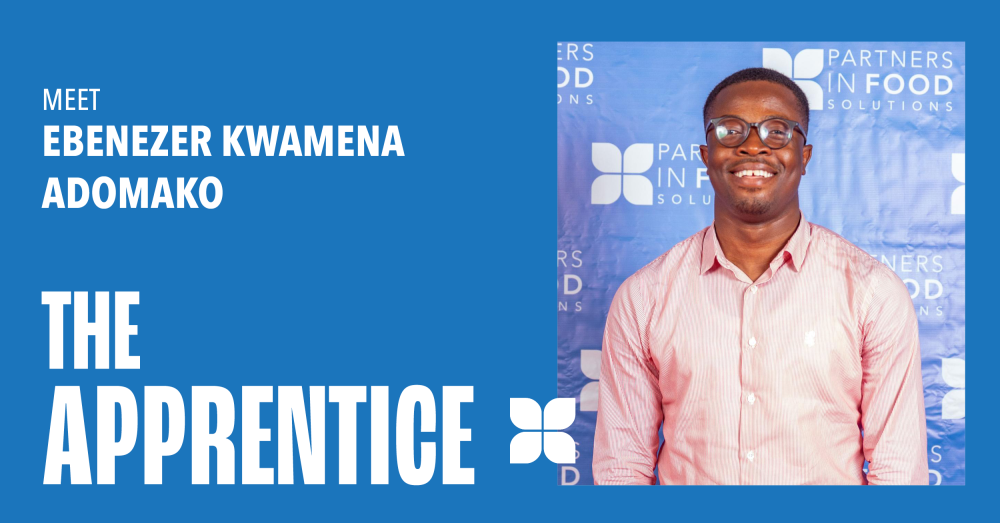
The Apprentice: How a PFS Apprenticeship Shaped Premium Foods' New Quality Assurance Manager.
When a product leaves Premium Foods Limited, someone has to be sure. Sure it's safe. Sure it meets the standard. Sure that if a regulator walks in tomorrow, everything holds up.
For the past several months, that someone has been Ebenezer Kwamena Adomako, newly promoted to Quality Assurance Manager after three years of building and strengthening the company's quality systems, first as its Quality Systems and Quality Assurance Supervisor, now as the person the whole function answers to.
It's a role built on judgment. And judgment isn't something you get from a lecture hall.
Ebenezer knows exactly where his came from.
Rewind back to 2019. Ebenezer is fresh out of the University of Cape Coast with a degree in Molecular Biology and Biotechnology, and the PFS Apprenticeship Program has just placed him at Juaben Oil Mills. It's his first time seeing what he'd studied actually at work, and his first time seeing what the textbooks leave out.
Because here's what a food processing plant teaches you that a syllabus can't. "I learnt the importance of having a quality management system implemented as part of operations in a food industry," Ebenezer says, not as paperwork on a shelf, but as something woven into the daily running of the business.
He also saw the harder truth up close: "I learnt and experienced the basic challenges faced by most food industries in trying to meet regulatory standards without the availability of expertise and adequate resources." Businesses that fully intended to meet the standard but lacked the specialists or the budget to chase it.
And out of that came the skill that has defined his career since. "I also learnt how best to establish an effective Health and Safety system taking an industry's available resources into account." Systems built for the organization you actually have, not the one a manual assumes.
"Having left school in pursuit of great on-the-job experience, this program did beyond that and has helped me in identifying some great opportunities in the food industry," he says.
Ebenezer stayed on at Juaben after the apprenticeship ended. Then came Premium Foods Limited, another PFS client, and the steady work of turning what he'd learned into systems other people could rely on.
Which brings us back to today, and to a detail we find quietly satisfying: the quality standards Ebenezer once studied as an apprentice are now standards he writes, enforces, and answers for. He didn't just pass through the system. He became it.
Seven years into this work, Africa's food industry doesn't just need more graduates. It needs more people who've had the chance to turn knowledge into judgment. That chance is what an apprenticeship at PFS is.
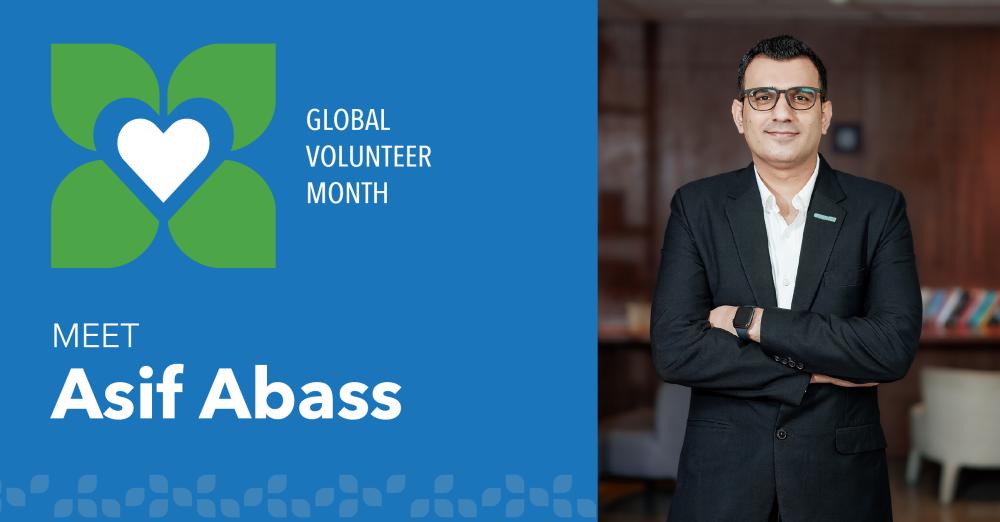
When Experience Crosses Continents: A Conversation With Asif Abass
Our volunteer spotlight series continues, and this week, we're featuring Asif Abass, Managing Director at Bühler in Ho Chi Minh City, Vietnam, whose 15 years in rice are quietly reshaping how millers across Africa do their work.
For Asif, rice isn't just an industry. It's a craft he's spent fifteen years learning, and one he's now found a meaningful way to give back to.
Based in Ho Chi Minh City as Managing Director at Bühler, Asif has built a career around the deep technical knowledge that turns raw paddy into high-quality milled rice, a chain that, when done well, can transform the economics of an entire food business. When the opportunity came to share that expertise with food entrepreneurs through Partners In Food Solutions, the appeal was simple.
"I've worked in the rice industry for about 15 years, so over time I've built up a lot of practical experience. Volunteering with PFS felt like a good opportunity to share that knowledge in a way that could really help others. For me, it was a chance to give back and support businesses in a practical and meaningful way."
That phrase, practical and meaningful, captures something essential about how Asif shows up to the work. His engagements aren't abstract. They produce things you can hold in your hands, point to on a factory floor, or measure on a yield report.
With Sajo Farms and Rice Mills in Nigeria, Asif helped develop quality control standards for paddy purchase, designing standard operating procedures for arrival and inspection, lab reporting, and testing. These are the kinds of foundational systems that determine whether a mill's quality is consistent or chaotic, whether it can negotiate from a position of strength with suppliers, and whether it can grow.
He's also contributed to a resource that will reach far beyond any one project, helping PFS develop customized training materials on rice milling best practices, designed to support rice milling clients across the network for years to come.
And with Fursa Foods, also in Nigeria, Asif tackled one of the most consequential metrics in the rice business: head rice yield. The project's goal, increasing yield from 53% to 60%, sounds modest on paper. In practice, those seven percentage points represent significant additional revenue, less waste, and a more competitive business.
This is what fifteen years of expertise looks like when it crosses continents.
But ask Asif what's stayed with him most through the work, and the answer goes beyond technical wins.
"What stood out most to me was seeing that the advice and training actually led to real improvements. It was very rewarding to see partners take the recommendations seriously and upgrade their rice milling facilities. That kind of result gives a lot of satisfaction."
There's something powerful about that loop, expertise shared, advice taken, change implemented. It's also what keeps him engaged.
"My experience can make a real difference. When you see people learn something useful, apply it, and improve their business, it gives you a strong sense of purpose. That is something I find very motivating."
That sense of purpose connects to a broader excitement about Africa's food sector, a sector Asif sees as full of possibility.
"There is so much potential in the food sector, and it is inspiring to be able to contribute by sharing knowledge and supporting improvement in quality, efficiency, and operations."
It's a perspective that captures why the PFS volunteer model works so well in practice. The continent doesn't lack talent or ambition. What it benefits from is access, to the kind of specialized, hard-won expertise that takes a career to build.
Asif is one of many volunteers helping bring that access closer. Project by project. Mill by mill. Yield point by yield point.
And in doing so, he's helping prove something simple but powerful: when experience crosses continents, food businesses don't just improve. They rise.
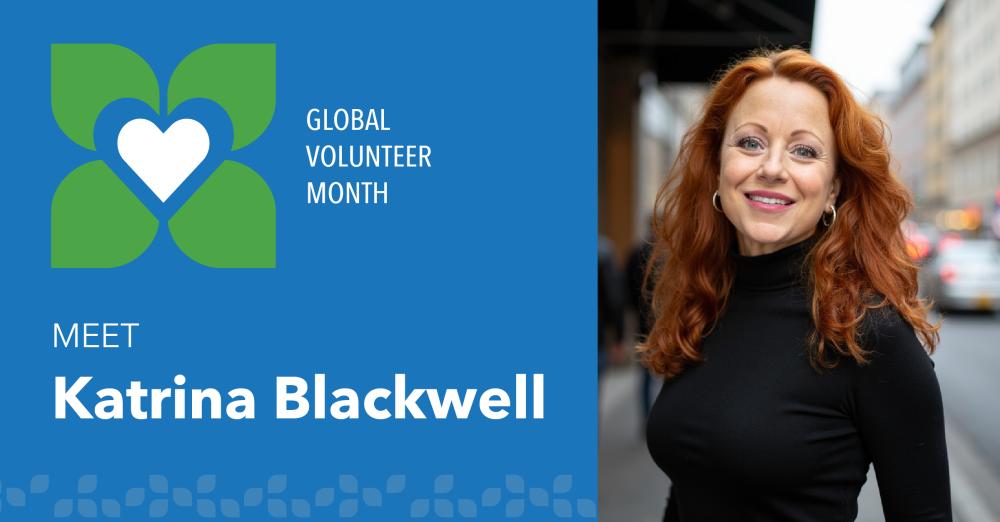
Beyond Process: The Human Side of Food Business
Most conversations about scaling a food business start with the technical: equipment, processes, food safety, supply chains. All essential. But ask anyone who has actually built or grown a company, and they'll tell you the harder challenges usually live somewhere else, in how teams are structured, how leaders make decisions, how culture holds together as a business expands.
That's the territory Katrina Blackwell knows well. And it's the territory she's been helping food businesses across Africa navigate.
"I was initially inspired to volunteer with PFS because I'm a values-driven person," she says. "I've always believed that the work I do should connect to something bigger something that helps enrich the lives of others."
Based in Tennessee and serving as Organizational Change Manager at Ardent Mills, Katrina brings expertise that doesn't always show up in technical project briefs but matters profoundly to the businesses PFS supports, the human side of growth. Helping organizations adapt. Helping leaders make decisions. Helping teams move forward together.
It's the kind of expertise that can be hard to come by, especially for early-stage food entrepreneurs navigating fast-moving change. And Katrina has put it to use across a range of engagements, supporting Powerfine in Zambia as they rethought their staffing structure, working with Souk Farm to review and implement KPIs that translate strategy into day-to-day performance, and mentoring staff at Umoyo, also in Zambia, on the HR challenges that come with growing a team.
Different projects. Different geographies. The same underlying need: helping food businesses build the people-side foundations to grow well.
But ask Katrina what's stayed with her most through the work, and the answer isn't about frameworks or deliverables. It's about the people on the other side of the screen.
"The individuals and organizations PFS connects us with are incredibly resourceful and dedicated. Working alongside them has been impactful, not just professionally, but personally. They make me want to be a better person, a more grateful person, and a more giving person."
That two-way exchange, where the volunteer is changed as much as the volunteered-for, is something Katrina has come to value deeply. It's also what keeps her coming back.
"I value the opportunity to share my expertise, but I also appreciate being stretched into areas I might not otherwise experience. It's a genuine growth opportunity for me professionally, and it's deeply rewarding. It feels good to know I'm contributing expertise that may not otherwise be accessible to PFS partners."
And that's true. Because for many of the food businesses PFS supports, access to specialized expertise, change management, organizational design, leadership development, isn't a given. It's often a gap that can quietly slow down growth, no matter how strong the product or the team. Katrina's contributions help close that gap.
What excites Katrina most is the ripple effect. These businesses aren’t just producing food.
"What excites me most about supporting food businesses across Africa is the broader impact. These entrepreneurs aren't just providing food, they're creating jobs, strengthening local economies, and expanding access in communities where opportunities can be limited. Being even a small part of that is something I don't take lightly."
It's a perspective that captures why the PFS model works. Volunteers like Katrina aren't just solving problems, they're investing in the kind of long-term capacity that lifts whole communities.
"PFS acts as an important bridge," she reflects, "between the people who have expertise to offer and the deserving organizations seeking support."
That bridge is built one volunteer at a time. And Katrina, with her conviction and willingness to keep showing up, is helping make it stronger.